THANK YOU FOR SUBSCRIBING

Hrtech Outlook Weekly Brief
Be first to read the latest tech news, Industry Leader's Insights, and CIO interviews of medium and large enterprises exclusively from Hrtech Outlook


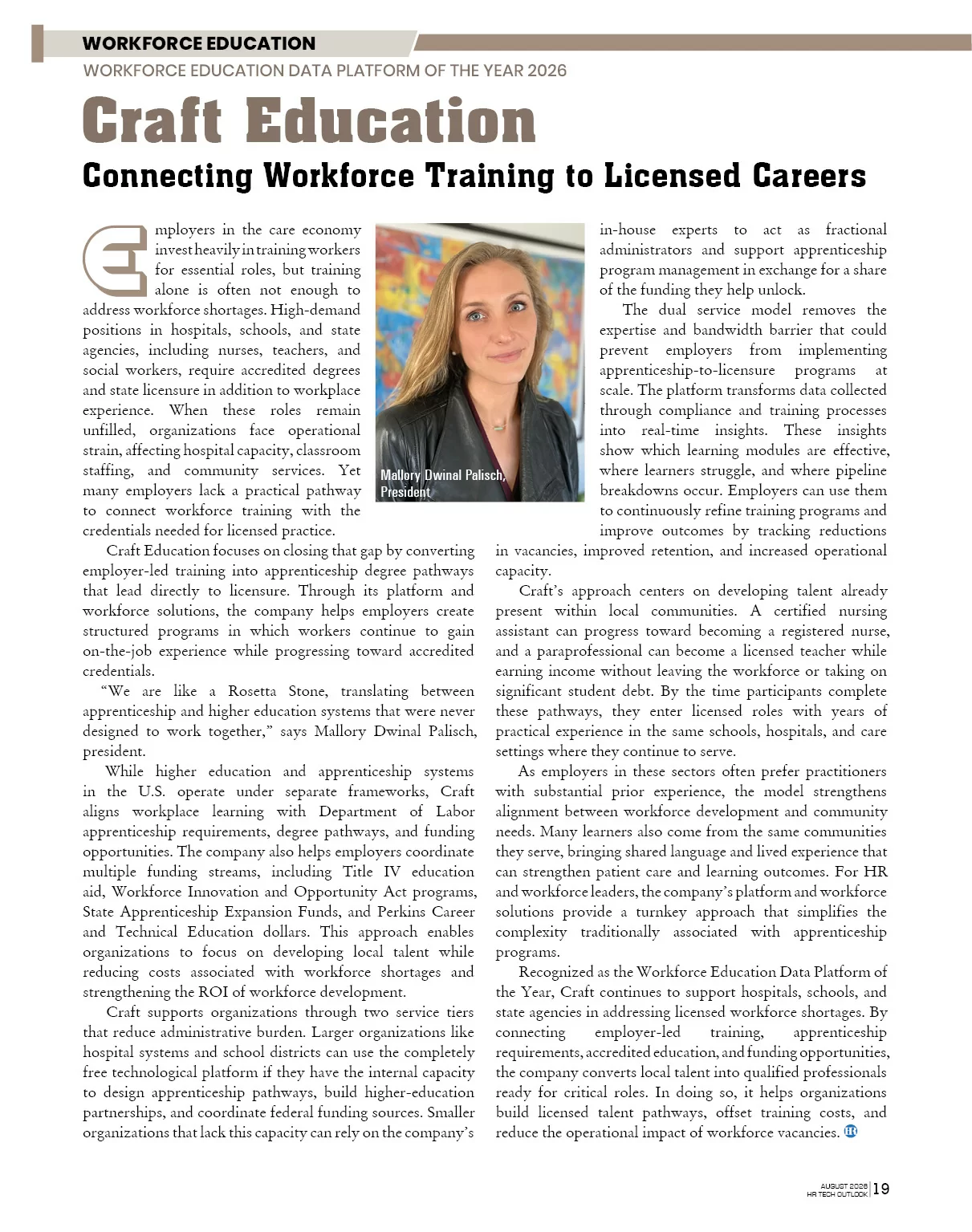
 Mallory Dwinal Palisch, President
Craft Education focuses on closing that gap by converting employer-led training into apprenticeship degree pathways that lead directly to licensure. Through its platform and workforce solutions, the company helps employers create structured programs in which workers continue to gain on-the-job experience while progressing toward accredited credentials.
“We are like a Rosetta Stone, translating between apprenticeship and higher education systems that were never designed to work together,” says Mallory Dwinal Palisch, president.
Craft supports organizations through two service tiers that reduce administrative burden. Larger organizations like hospital systems and school districts can use the completely free technological platform if they have the internal capacity to design apprenticeship pathways, build higher-education partnerships, and coordinate federal funding sources. Smaller organizations that lack this capacity can rely on the company’s in-house experts to act as fractional administrators and support apprenticeship program management in exchange for a share of the funding they help unlock.
The dual service model removes the expertise and bandwidth barrier that could prevent employers from implementing apprenticeship-to-licensure programs at scale. The platform transforms data collected through compliance and training processes into real-time insights. These insights show which learning modules are effective, where learners struggle, and where pipeline breakdowns occur. Employers can use them to continuously refine training programs and improve outcomes by tracking reductions in vacancies, improved retention, and increased operational capacity.
As employers in these sectors often prefer practitioners with substantial prior experience, the model strengthens alignment between workforce development and community needs. Many learners also come from the same communities they serve, bringing shared language and lived experience that can strengthen patient care and learning outcomes. For HR and workforce leaders, the company’s platform and workforce solutions provide a turnkey approach that simplifies the complexity traditionally associated with apprenticeship programs.
Recognized as the Workforce Education Data Platform of the Year, Craft continues to support hospitals, schools, and state agencies in addressing licensed workforce shortages. By connecting employer-led training, apprenticeship requirements, accredited education, and funding opportunities, the company converts local talent into qualified professionals ready for critical roles. In doing so, it helps organizations build licensed talent pathways, offset training costs, and reduce the operational impact of workforce vacancies.
What Are Workforce Education Data Platforms?
Workforce Education Data Platforms bring learner records, competency tracking, reporting, compliance and workforce outcomes together in one system. Instead of relying on disconnected spreadsheets and manual processes, organizations gain a centralized source of information that supports better oversight and more informed decisions. These platforms are especially useful for apprenticeship and work-based learning programs that need to document progress, demonstrate measurable results and maintain accurate records over time.
How Does Craft Education Support Workforce Education Data Platforms?
Craft Education shows how Workforce Education Data Platforms can simplify apprenticeship and work-based learning administration. The platform brings learner records, competency tracking, time tracking, mentor feedback and audit-ready reporting into one environment. It also supports healthcare and education pathways while helping organizations handle funding requirements, compliance and day-to-day program administration without switching between multiple systems.
What Features Should Organizations Look for in Workforce Education Data Platforms?
The strongest Workforce Education Data Platforms combine real-time learner progress, competency tracking, secure recordkeeping, reporting automation and collaboration for learners, mentors, educators and administrators. An effective apprenticeship management platform should also integrate with existing systems, scale as programs grow and support compliance reporting. These capabilities reduce manual work while giving organizations a clearer view of learner development.
How Do Workforce Education Data Platforms Improve Program Outcomes?
Rather than piecing together information from separate tools, Workforce Education Data Platforms give administrators consistent, up-to-date records across every stage of work-based learning. Teams can identify learning gaps sooner, monitor competency tracking, generate reports more efficiently and spend less time on paperwork. Reliable information also supports funding accountability, accreditation efforts and long-term workforce planning.
Why Is Craft Education Recognized for Workforce Education Data Platforms?
Craft Education has built its apprenticeship management platform around apprenticeship and work-based learning, combining program administration with measurable workforce results. The platform maintains audit-ready records, documents on-the-job training and produces reporting that supports compliance and funding requirements. It also serves healthcare and education pathways while remaining flexible enough to support additional workforce programs as organizations expand.
How Can Organizations Evaluate Workforce Education Data Platforms Before Selecting One?
When comparing Workforce Education Data Platforms, organizations should consider reporting needs, compliance obligations, workforce programs and future growth. They should also look at implementation, ease of use, analytics, collaboration and data accuracy. An apprenticeship management platform that connects operational workflows with measurable workforce insights can help organizations build sustainable work-based learning programs that continue delivering value as they expand.
Company
Craft Education
Management
Mallory Dwinal Palisch, President
Description
Craft Education is a nonprofit education technology company focused on apprenticeship and work-based learning programs. It provides a platform connecting employers, educators, and policymakers to design, track, and manage on-the-job training aligned with skills, credentials, and workforce needs. Craft’s mission is to reduce labor shortages and expand debt-free career pathways.